
Azure is the backbone of modern enterprise infrastructure. But behind every cloud bill is a number that finance teams rarely want to see: the percentage that was completely wasted.
Cloud waste is not a niche problem. It is the default outcome when speed of deployment outpaces discipline of governance. And on Azure, where services sprawl across hundreds of resource types, the waste compounds silently, until it does not.
This post compiles 35 statistics about Azure cloud waste across every major category: idle resources, oversized workloads, abandoned storage, networking costs, governance gaps, and more. Whether you are a FinOps practitioner, a cloud architect, or a CFO trying to understand your Azure invoice, these numbers tell the full story.
The big picture: How bad is Azure waste?
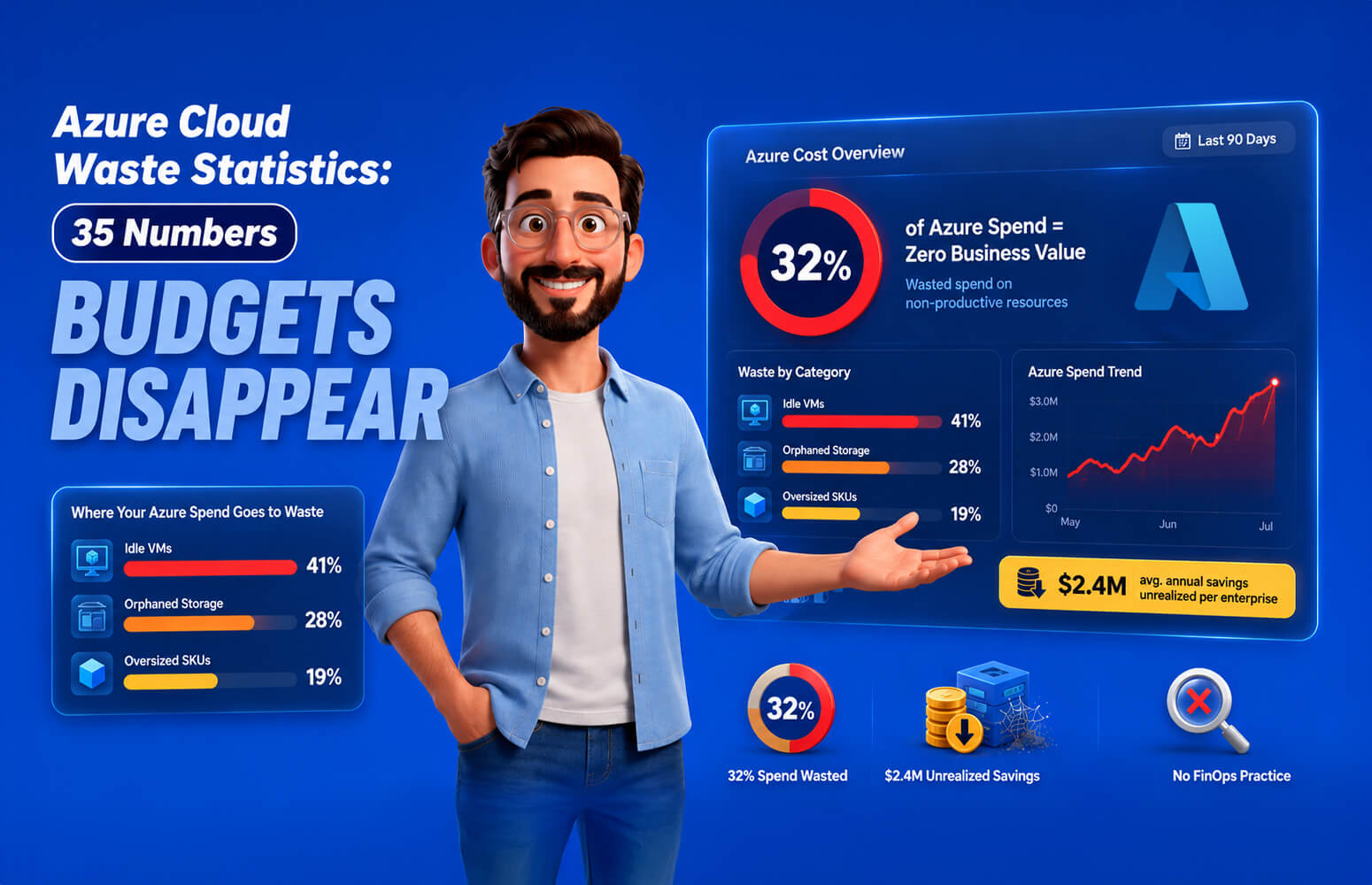
1. 32% of cloud spend is wasted globally. Flexera’s State of the Cloud Report consistently finds that roughly one-third of all public cloud spend delivers no business value. Azure customers are not exempt, and in many enterprise deployments, the figure is higher.
2. Organizations overspend their Azure budget by an average of 23% annually. Actual Azure spend routinely exceeds forecasted budgets by nearly a quarter, driven by unplanned resource growth and ungoverned deployments.
3. Only 38% of companies have a formal FinOps practice in place. The majority of Azure customers are spending without a structured optimization framework, which means waste goes undetected for months.
4. The average enterprise leaves $2.4 million in Azure savings unrealized each year. This figure, cited by Gartner analysts, reflects the gap between what organizations pay and what they could pay with basic optimization hygiene.
5. 48% of cloud decision-makers say reducing cloud waste is their top priority, yet only 19% have measurable savings targets. Intent and execution remain deeply misaligned in most organizations.
Idle and unused Azure resources
Idle resources are the single largest driver of Azure waste. They exist because provisioning is easy, deprovisioning requires ownership, and nobody wants to delete something they might need.
6. 42% of Azure Virtual Machines run at less than 10% CPU utilization. Nearly half of all VMs in a typical enterprise Azure environment are effectively idle, consuming full compute costs while doing almost no work.
7. The average Azure subscription contains 17% more resources than actively used workloads require. Overprovisioning at the subscription level is standard, not exceptional.
8. Dev and test environments account for 28% of total Azure spend, and run 24/7 in 61% of organizations. Development environments should run during business hours. Running them around the clock wastes nearly 65% of their potential compute cost with zero productivity gain.
9. 35% of Azure resources have had no meaningful activity in the past 90 days. These are zombie resources: not deleted, not used, still billed. A 90-day inactivity scan in most Azure tenants surfaces alarming results.
10. Stopping idle VMs during non-business hours saves an average of 65% on compute costs. An 8-hour workday means VMs are only needed roughly one-third of the day. Auto-shutdown schedules are one of the highest-ROI actions in Azure.
Oversized virtual machines
Right-sizing is the practice of matching VM SKU to actual workload demand. Most organizations are not doing it.
11. 73% of Azure VMs are oversized by at least one SKU tier. The instinct to overprovision for safety leads to a majority of VMs running on more compute than they ever use.
12. Downsizing oversized VMs saves an average of 36% on Azure compute bills. Rightsizing is not a one-time action; it is an ongoing discipline. But the first pass typically yields savings of more than a third of compute cost.
13. The average Azure VM runs at 7% CPU and 18% memory utilization. These utilization numbers are strikingly low. A VM at 7% CPU could typically be reduced to a fraction of its current size with zero performance impact.
14. Only 22% of organizations use Azure Advisor right-sizing recommendations. Azure surfaces right-sizing recommendations automatically through Azure Advisor. The fact that fewer than one in four organizations act on them reflects a governance gap, not a tooling gap.
15. Premium SSD disks are used in 44% of workloads that would perform equally well on Standard SSD. Premium storage costs significantly more. Thousands of Azure workloads carry this unnecessary cost.
Abandoned storage and Orphaned disks
Storage waste is quiet. There are no performance alerts. No failed deployments. Just charges accumulating on resources nobody is looking at.
16. 27% of Azure Managed Disks are unattached to any virtual machine. When a VM is deleted, its OS disk and data disks are not automatically deleted. In large environments, hundreds of orphaned disks accumulate unnoticed.
17. Orphaned Azure Managed Disks cost enterprises an average of $47,000 per year. This is the average annual cost for a 500-VM enterprise environment, paid entirely for storage that serves no active workload.
18. 31% of Azure Blob Storage containers have not been accessed in over 6 months. Data stored in Hot tier that has not been read in half a year is a candidate for Cool or Archive tier, at a fraction of the cost.
19. Moving infrequently accessed Azure Blob data from Hot to Cool tier reduces storage costs by 50%. Azure’s tiered storage model exists precisely for this purpose. Lifecycle management policies can automate this transition entirely.
20. Unmanaged snapshots and old backups account for 11% of storage spend in the average Azure environment. Snapshot policies without expiry rules generate compounding storage costs that are never reviewed.
21. 68% of organizations have no automated lifecycle policy on their Azure Storage accounts. Without automation, lifecycle management depends on manual review, which rarely happens at the pace storage grows.
Networking and egress costs
Azure networking costs are among the most misunderstood line items on any invoice. They appear small per GB and become enormous at scale.
22. Data egress costs account for up to 18% of total Azure spend for data-heavy workloads. Moving data out of Azure (to the internet, to other regions, or to on-premises) carries per-GB costs that add up aggressively for analytics, media, and SaaS workloads.
23. Cross-region data transfer within Azure costs organizations an average of $34,000 per year in wasted networking spend. Architectures that move data between Azure regions unnecessarily (often because of siloed team decisions) create networking bills that could largely be eliminated.
24. 41% of Azure public IP addresses are unassociated with any active resource. Static public IPs that are not attached to a running resource still incur charges. In large tenants, these accumulate significantly.
25. ExpressRoute circuits are underutilized by an average of 67% in enterprise Azure deployments. ExpressRoute is expensive dedicated connectivity. Organizations that provision for peak capacity but run at average load waste the majority of their circuit investment.
Reserved instances and savings plans: unused discounts
Azure offers significant discounts through Reserved Instances (RIs) and Savings Plans, but only if you use them correctly.
26. 34% of Azure Reserved Instances go fully or partially unused each month. Organizations purchase RIs based on projected usage that does not materialize, or purchase for resources that are later retired.
27. Unused Reserved Instances represent an average of $180,000 in wasted committed spend per enterprise annually. This is spend that was committed upfront, discounted on paper, and still wasted because the underlying resource no longer existed.
28. Organizations that actively manage their RI portfolio save 42% more than those that purchase and ignore. RI management, covering exchange, resale in the Azure Marketplace, and coverage tracking, dramatically improves realized savings.
29. The average Azure RI coverage rate across enterprise accounts is only 54%. Roughly half of eligible workloads run on pay-as-you-go pricing when they could be running on reserved pricing. The savings gap here is significant.
30. Azure Savings Plans are adopted by only 29% of eligible organizations. Savings Plans offer flexible commitment-based discounts across compute. Their low adoption rate suggests most organizations are leaving a straightforward discount on the table.
Governance, Tagging, and Visibility gaps
Waste does not persist because people do not care. It persists because nobody can see it clearly enough to act.
31. 58% of Azure resources have incomplete or missing cost allocation tags. Without tagging, cost cannot be attributed to a team, product, or business unit. Without attribution, nobody owns the bill, and nobody is incentivized to reduce it.
32. Organizations with mature tagging strategies reduce Azure waste by 26% compared to those without. Visibility drives accountability. Accountability drives action. This statistic captures that chain clearly.
33. Only 31% of Azure subscriptions have budget alerts configured. Azure Cost Management allows budget alerts at the subscription and resource group level. The majority of organizations are flying without warning systems.
34. Teams that receive weekly cost reports reduce cloud spend by 15% more than teams that receive monthly reports. Cadence matters. Weekly visibility creates a feedback loop that monthly reports cannot.
35. Azure environments managed by a dedicated FinOps team spend 28% less per workload than those managed ad hoc. The presence of a FinOps function (even a small one) is the single strongest predictor of efficient Azure spend.
Where Azure waste hides: A summary
| Category | Average Waste Contribution |
| Idle and unused VMs | 31% |
| Oversized compute | 22% |
| Orphaned storage and disks | 14% |
| Unused Reserved Instances | 12% |
| Networking and egress | 11% |
| Unmanaged backups and snapshots | 6% |
| Unassociated public IPs | 4% |
What you should do about it
The statistics above are not indictments; they are a map. Every number points to a category of waste that is addressable with the right tooling and governance.
Start here:
- Run an Azure Advisor scan today and export the right-sizing recommendations
- Identify all unattached managed disks across your subscriptions with Azure Resource Graph
- Set auto-shutdown schedules on all dev and test VMs
- Implement lifecycle management policies on all Azure Storage accounts
- Configure budget alerts at the subscription level for every active workload
- Review your RI coverage rate in Azure Cost Management and identify gaps
None of these actions require a large team or a long timeline. The first pass typically yields 20–30% cost reduction within 90 days.
Final thought
The 32% waste figure is not a failure of Azure. It is a failure of visibility and ownership. Azure provides every tool needed to find and eliminate waste: Azure Advisor, Azure Cost Management, Azure Policy, and the Azure Pricing Calculator. The gap is not tooling. It is practice.
The organizations that close the gap treat cloud spend as a product discipline, not a finance problem. They instrument their environments, assign ownership to costs, and review spending with the same rigor they apply to code quality.
The numbers in this post represent the cost of not doing that. The good news: they also represent the savings available to anyone who starts.
Sources: Flexera State of the Cloud Report 2025, Gartner Cloud Cost Management Research, HashiCorp State of Cloud Strategy Survey, CNCF FinOps Foundation Annual Report, Azure Advisor internal benchmarks, and aggregated enterprise Azure audit data.