

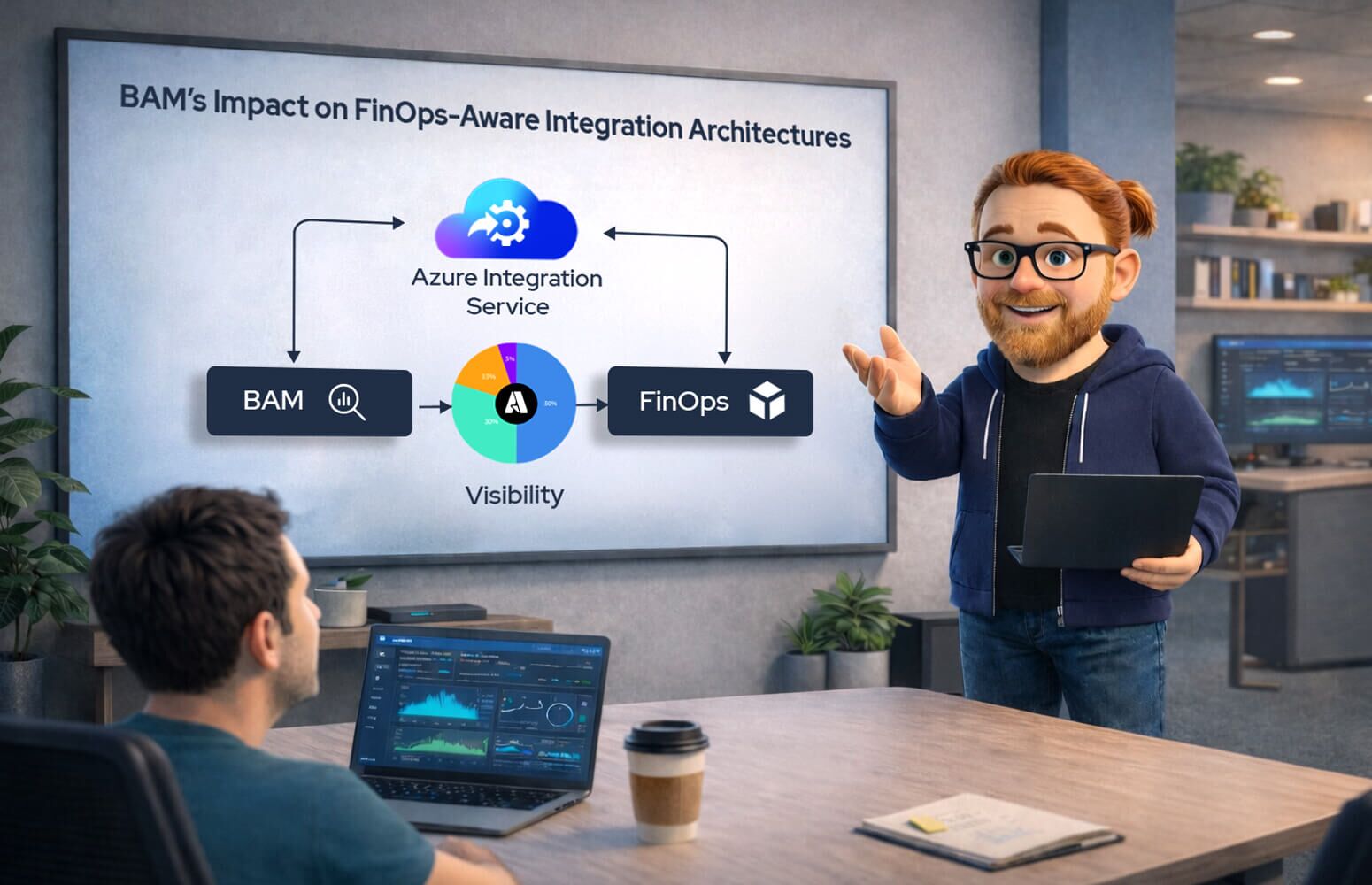
As more organizations move to Azure Integration Services, they’re realizing something important: it’s not enough for integrations to just work but they need to be visible, measurable, and cost-effective.
That’s where the disciplines of Business Activity Monitoring (BAM) and FinOps intersect. In FinOps world we are in the area of Unit Economics.
Both aim to create visibility and accountability, but they look at it from different angles:
- FinOps focuses on financial transparency – “Where is our money going, and why?”
- BAM focuses on business transparency – “What’s flowing through our systems, and how well is it performing?”
Together, they give System Integrators the tools to deliver integration solutions that are not just functional, but financially intelligent.
Visibility: The common language of FinOps and BAM
Both FinOps and BAM are built on a shared foundation, that is observability.
| Discipline | What It Observes | Key Stakeholders |
| FinOps | Cloud spend, utilization, waste, and ROI | Finance, Cloud Ops, Leadership |
| BAM | Business transactions, milestones, outcomes | Business Users, Operations, IT |
When an System Integrators brings both perspectives together in a single solution, customers gain end-to-end clarity:
- They can see what’s happening technically.
- Understand how it impacts the business.
- Track how those activities drive cloud cost and value.
This is what a FinOps-aware integration strategy looks like visibility from both sides of the equation: performance and spend.
Why integration teams need FinOps thinking
Cloud-native integration is inherently distributed. Each Logic App, Function, Service Bus, and API call contributes to your overall cost structure.
Without financial awareness, it’s easy for costs to grow silently, especially in high-volume or event-driven architectures.
But with the right approach, cost and business activity data can work together to tell a complete story:
| Integration Example | Business View (BAM) | Financial View (FinOps) |
| Order-to-Cash Process | “We processed 10,000 orders today.” | “Logic App X consumed $24, Functions $3.50, API Management $5.” |
| Failed Invoice Scenario | “300 invoices failed due to validation errors.” | “Each retry added $0.02 in consumption – $6 in waste.” |
| Batch Reprocessing | “Data Factory re-ran 5 times.” | “$40 of unnecessary compute from duplicate runs.” |
BAM gives context to cost. FinOps gives cost to context. Together, they unlock true cost-to-value insight.
Turbo360 BAM: The bridge between business and financial visibility
Turbo360 BAM already gives organizations a business-centric view of their Azure integrations showing transactions, milestones, and outcomes in real time.
But when combined with Turbo360 Cost Analyzer (or your customer’s FinOps practice), System Integrators can deliver a holistic story of value:
- Which business processes consume the most Azure resources
- Where inefficiencies in transactions drive unnecessary spend
- How business volume aligns with cost trends
For example: Instead of saying “Logic App consumption increased 20% this month,” FinOps + BAM reveals “Invoice processing volume increased 20% while cost per transaction stayed flat – proving efficiency gains.”
How System Integrators can build FinOps-Aware solutions
Here’s a step-by-step framework System Integrators can use to embed FinOps thinking into their integration delivery methodology:
Capture Business Context (BAM Layer)
Use Turbo360 BAM to define business processes, milestones, and identifiers within your Azure integrations.
Correlate Resource Cost (FinOps Layer)
Tag and attribute Azure costs to the same processes – e.g., “Order Processing,” “Invoice Dispatch.”
Analyze Cost per Business Transaction
Combine data from BAM and cost analysis to calculate unit economics (cost per order, per invoice, etc.).
Optimize Based on Insight
Use the visibility to rightsize components, tune retries, and automate scaling based on business demand.
Communicate Value
Show customers not just technical performance but cost performance.
This gives System Integrators a consultative advantage: you’re no longer just delivering integrations but you’re helping customers understand the economic value of every flow.
Real-world example: E-commerce order processing
Scenario:
A retail customer’s Azure Integration platform processes 50,000 online orders per day through Logic Apps, Functions, and Service Bus.
Without BAM & FinOps:
The customer knows total Azure spend but not why it changes. When costs spike, investigation is slow and reactive.
With Turbo360 BAM & Cost Analyzer:
- BAM shows transaction volumes and success rates.
- FinOps shows cost per order.
- Combined dashboards reveal that retries due to invalid data are responsible for 15% of total Logic App cost.
With that insight, the System Integrators helps the customer fix data validation early in the process saving thousands per month and improving throughput.
That’s how BAM transforms FinOps data from numbers into actionable intelligence.
Strategic benefits for System Integrators
| Benefit | Description |
| Differentiate Your Offer | Go beyond technical delivery – offer business + financial visibility as a unified solution. |
| Strengthen Stakeholder Alignment | Give finance, operations, and IT a shared view of how integrations drive value. |
| Build Long-Term Engagements | Position BAM + FinOps as a managed insight service, not just a one-off implementation. |
| Prove Business Value | Use transaction and cost metrics to demonstrate ROI from your integration projects. |
The future: Intelligent integration economics
As Azure evolves, integration cost and performance will become increasingly data-driven. System Integrators who measure integration business value beyond functionality will dominate the market.
Turbo360 BAM and Cost Analyzer together make that possible:
- BAM gives visibility into business flow.
- FinOps gives insight into cost efficiency.
- Together, they deliver integration economics – the ability to optimize cloud operations in business terms.
Final thought
Modern integration isn’t just about connecting systems, it’s about connecting technology, business, and cost.
By embedding Turbo360 BAM into your Azure Integration solutions, System Integrators can create a FinOps-aware architecture where every transaction is visible, every dollar is accountable, and every customer sees the true value of their integration investment.


