

Global cloud infrastructure spending is heading toward $330 billion in 2026, according to Gartner. Public cloud spending broadly is projected to hit $1 trillion for the first time, per Forrester.
$182B
in cloud spend wasted globally in 2026 – unchanged for three consecutive years
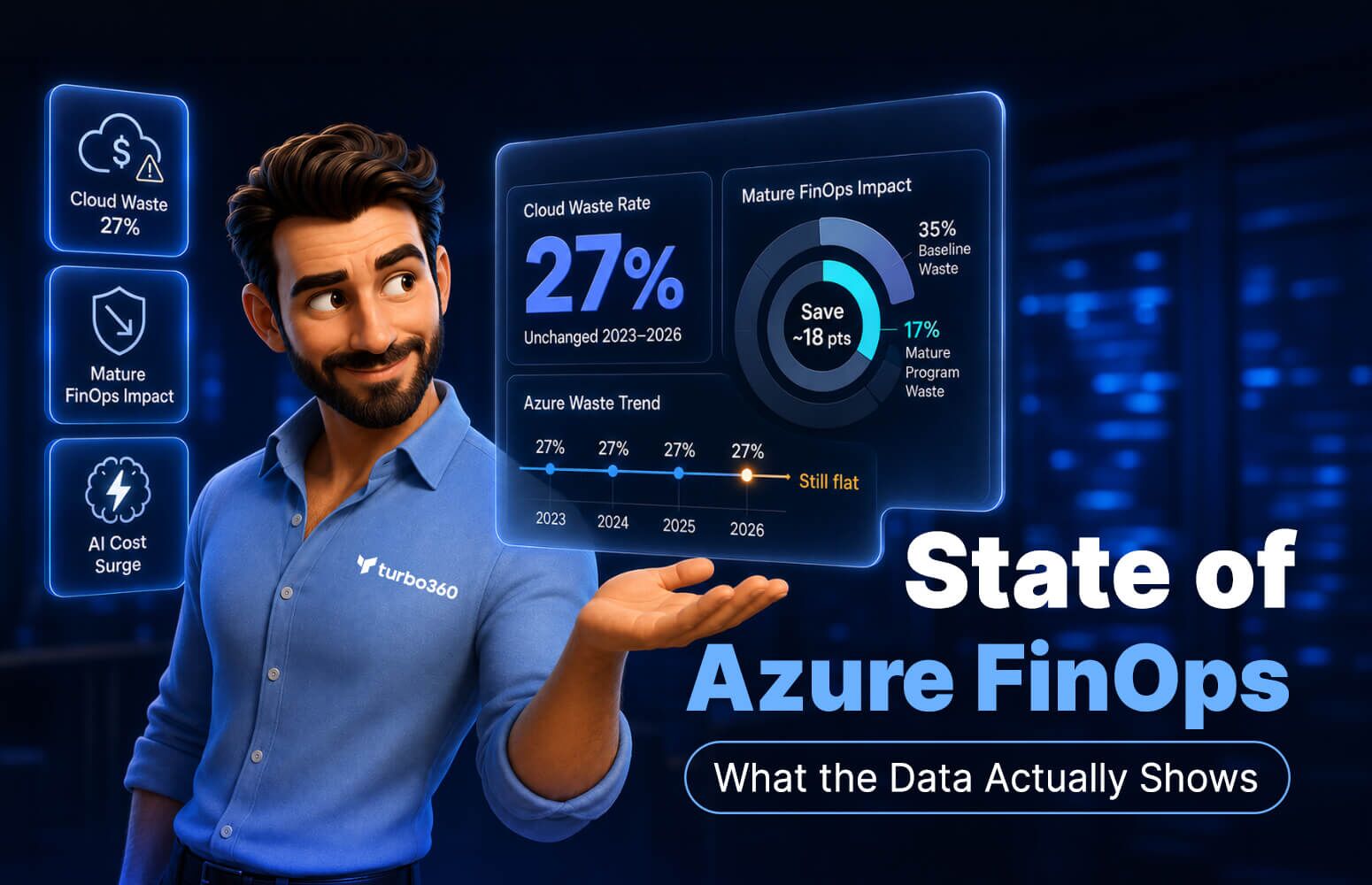
That’s roughly $182 billion in idle compute, overprovisioned instances, and orphaned storage that organisations are paying for every single year without getting anything back. The number hasn’t moved in three years – 27% in 2023, 27% in 2024, and 27% again in 2026 – despite more tooling, more practitioners, and more boardroom attention than the discipline has ever had.
For Azure specifically: the average organisation runs cloud infrastructure at 35% waste, including among the top quartile of most sophisticated operators. Organisations without FinOps programs waste 32-40% of cloud spend, while mature FinOps programs reduce this to 15-20%.
That gap – between worst and best performers – is where the real story of Azure FinOps in 2026 lives.
Knowing where the discipline stands is one thing; closing the gap is another. The teams cutting waste from 35% down to 15-20% aren’t doing it manually-they’re backed by tooling built to surface idle compute, flag overprovisioning, and manage reservations at scale. If you’re evaluating what’s available, our guide to the best Azure FinOps tools breaks down the options by use case, so you can match a platform to the specific problems your practice is trying to solve.
Where Azure FinOps sits in 2026: the maturity picture
63%
of organisations now have a dedicated FinOps team – up from 51% in 2024
Azure’s footprint continues to grow. Azure follows AWS at 32% of enterprise primary cloud spending. In Europe specifically, 52% of respondents are running significant workloads on Azure, compared to AWS at 41%.
78%
of FinOps practices now report into the CTO/CIO organisation – up 18% since 2023
That’s a significant structural shift. When FinOps reports to the CTO rather than the CFO, it stops being a cost-reduction function and starts being a capability function. The questions change from ‘how do we cut the bill?’ to ‘how do we make sure architecture decisions account for cost from the start?’
The most common team structure remains centralised enablement (60%), followed by hub-and-spoke models (21%) which are more common in large enterprises.
The six biggest shifts in Azure FinOps this year
1. AI cost management went from a future concern to a current crisis
AI management has become nearly universal at 98% of FinOps teams (up from 63%). AI-related workloads now make up 19% of total cloud spending, up from 8% in 2023. The average enterprise spends $1.7 million per year on AI cloud services. Inference workloads now consume more compute than training for the first time – and inference costs on Azure scale with user behaviour in ways that are much harder to predict and attribute.
2. The scope of FinOps exploded beyond public cloud
90% of respondents now manage SaaS costs (up from 65% in 2025), alongside licensing (64%, up 15%), private cloud (57%, up 18%), and data centre (48%, up 12%). For Azure-focused teams, this means Microsoft 365, Dynamics, GitHub Enterprise, and Azure DevOps are now FinOps territory – not just Azure consumption.
3. The ‘easy wins’ are gone
Practitioners report diminishing returns: ‘We have hit the big rocks of waste and now face a high volume of smaller opportunities that require more effort to capture.’ One team described reaching 97% optimisation in their Cost Optimisation Hub, with the remaining 3% intentionally not actioned for business reasons.
4. Unit economics became the new target metric
Mature FinOps practices are less about cutting costs alone and more about increasing the value technology investments deliver. The shift is from ‘how much are we spending?’ to ‘what are we getting for what we spend?’ – cost per customer, cost per transaction, cost per API call.
5. Automation is no longer optional
FinOps teams remain lean and scale through AI productivity and automation rather than headcount growth. Organisations managing $100M+ in cloud spend typically have 8-10 practitioners. Manual FinOps simply cannot keep pace with the scale and speed of modern Azure environments.
6. Tagging alone stopped working as a cost allocation strategy
54% of cloud waste stems from a lack of cost visibility, and 50% say complex pricing models make cost control harder. As Azure environments grow more complex, the tagging coverage that used to be ‘good enough’ starts to leave 20-30% of spend unallocated. The 2026 response: better governance tooling plus platforms that allocate costs through alternative mechanisms when tags are absent.
Azure waste in 2026: what’s being lost and why
Organisations waste 27% of cloud spend – over $100B globally in 2026. Here’s where Azure money disappears, specifically.
35%
Idle compute Dev/test environments running continuously, VMs for ended projects, environments that should schedule off on evenings and weekends but don’t. Fewer than 20% of organisations have automatic shutdown policies for GPU instances.
25%
Overprovisioned instances VMs sized for expected peak traffic that never arrives. Nobody downsizes because there’s perceived risk and very little immediate consequence to leaving things as-is.
~15%
Orphaned storage Managed disks not attached to any VM still cost money. Storage accounts from deprecated applications. Snapshots and backups without retention policies.
~10%
Unused / misaligned commitments Reservation portfolios built under EA assumptions that no longer hold after migration to MCA-E. Coverage gaps and over-commitments both destroy value.
“How are you supposed to eliminate this waste when you can’t even see it? The visibility problem comes first. The remediation problem comes second. Most teams are still working on the first one.”
AI workloads: the cost management problem nobody was ready for
$1.7M
average enterprise spend per year on AI cloud services in 2026
GPU-as-a-Service has grown into a $12 billion market on its own. The standard Azure FinOps playbook doesn’t port cleanly to AI workloads. Three reasons:
- Token-based billing. Azure OpenAI charges per token rather than per compute hour. Your cost model changes every time your usage patterns change – a shift in prompt length, a new feature that calls the API more frequently, a change in model version. Traditional budget forecasting isn’t enough.
- Attribution is hard. A training run costing $40K might benefit five different product teams simultaneously. Traditional cost allocation – subscription, resource group, tag – doesn’t capture that shared ownership.
- GPU instance waste is expensive. GPU instances are significantly more expensive than general-purpose compute, so the waste multiplier is correspondingly higher. A large idle GPU VM can cost more per day than an entire rack of underutilised standard VMs.
The 2026 best practice for Azure AI cost management: dedicated Azure subscriptions for AI workloads, token-level budgets with automated alerts, AI-specific tagging (ModelType, TrainingCost, InferenceTier), and governance policies that prevent GPU instances from running outside active training or inference windows.
AI cost management
is the single most desired FinOps skillset across all organisation sizes in 2026
The EA-to-MCA migration: a billing shift with real cost consequences
43%
of organisations still on Azure Enterprise Agreement – down significantly as Microsoft phases it out
This is the single most disruptive change in Azure commercial structures in the last two years, and it’s still playing out across thousands of enterprise accounts.
Under MCA-E, MACC tracks via Azure Plan – not the old monetary commitment model. Teams that assumed discounts would scale naturally with enterprise spend are now working from a baseline that’s lower than they think. Building commitments on top of an inflated baseline creates waste that compounds month over month.
- Review every active reservation and savings plan against your new MCA-E baseline before renewal
- Don’t assume volume discounts will behave the same way they did under EA
- Map MACC contribution across all subscriptions monthly – not quarterly – during the migration window
- Get tagging governance in place before migration, not after; the MCA-E allocation model requires it
- Watch for stranded costs on the EA during the transition period that falls within your MACC burn-down window
Reservations and Savings Plans: the 2026 picture
Upto 72%
savings available through Azure Reserved Instances for steady-state workloads
Azure commitments in 2026 aren’t ‘set it and forget it’ anymore. Between EA pricing changes, MCA migration, the uncertainty around reservation exchanges, and the rise of AI commitments, the old playbook can quickly turn into a cost trap.
Three structural changes hit Azure commitment economics within the same window: the reservation exchange policy (swapping compute reservations across VM series and regions) has been extended ‘until further notice’ as of March 2026 – originally due to end January 2024. AI commitments are a new category with different rules. And the baseline shift from EA to MCA-E means reservation coverage calculations need to be rechecked from scratch for any team that’s migrated in the last 12-18 months.
The teams doing this well run continuous commitment management – reviewing coverage weekly, using actual usage data to drive recommendations, and treating reservation purchasing as an ongoing operational workflow rather than a periodic finance exercise.
FinOps team structure: who owns Azure costs now
8-10 FTEs
typical FinOps team size even at $100M+ cloud spend
Small teams. Big problems. The only sustainable response is automation.
FinOps under the CTO/CIO creates stronger alignment with engineering and platform teams, enabling earlier influence on technology decisions and reinforcing the broader ‘shift left’ trend. ‘Shift left’ in FinOps means cost implications are considered at design time rather than discovered at billing time.
The hub-and-spoke model – a small central FinOps team owning governance and tooling, with cost champions embedded in each engineering team – is the structure that scales best for large Azure environments. It combines centralised expertise with distributed accountability.
For MSPs and CSPs, the structural challenge is different: centralised visibility across all customer environments, customer-level cost breakdown without shared credentials, white-labelled reporting for each customer, and scalable management across many Azure tenants.
What leading Azure FinOps teams do differently
They automate the remediation, not just the detection.
Most FinOps tools find waste. Fewer do anything about it without human intervention. The best teams have automated shutdown policies, rightsizing workflows with configurable approval gates, and anomaly alerts that trigger action rather than just notifications.
They track cost at the business unit level, not the resource level.
A cost spike in a single VM is noise. A cost trend in a customer environment or product line is signal. The FinOps teams closing the gap have mapped their Azure resource hierarchy to their business structure – and maintained that mapping as both changed.
They treat reservation management as an ongoing process.
The best teams review their commitment portfolio monthly, not annually. They use actual usage data rather than historical spend to drive recommendations and don’t let reservation purchases sit untouched while their workload mix evolves.
They’ve built a cost culture, not just a cost team.
Only 44% of organisations have implemented chargeback or showback. In organisations without it, the waste rate is consistently higher. Making engineering teams aware of and accountable for costs they generate changes behaviour in ways no amount of centralised cost management can replicate.
They use AI agents for analysis, not just dashboards.
The shift in 2026 is from practitioners pulling reports to AI agents surfacing insights proactively. Asking ‘what’s driving our storage cost spike this week?’ in natural language and getting a specific, actionable answer is categorically different from building a filter in a cost dashboard.
The Turbo360 take: what this means for your practice
1
Get serious about AI cost visibility now. If you don’t have dedicated Azure subscriptions for AI workloads, a token-level budget framework, and AI-specific tagging in place, you’re flying blind on the fastest-growing cost category in your Azure bill. The governance you put in place now will determine whether AI workloads are manageable at scale a year from now. Turbo360’s AI Agents surface these insights in natural language – turbo360.com/ai-agents
2
Review your reservation portfolio against your MCA-E baseline. If your organisation migrated from EA to MCA-E in the last 18 months – or is currently migrating – your existing commitments need a full review. Don’t assume the coverage and discount calculations that made sense under EA still apply. See turbo360.com/reservations for guidance specific to the migration window.
3
Automate before you optimise. The organisations stuck at 30%+ waste aren’t stuck because they lack visibility. They’re stuck because the gap between seeing an opportunity and acting on it is too wide. If your FinOps practice still relies on human intervention for routine actions – shutting down idle resources, enforcing tagging policies, scaling down underutilised VMs – automation should be your first investment, not your last.
4
Build showback before you build chargeback. Start with showing teams what they’re spending without billing them – to build cultural awareness and trust in the data that makes chargeback sustainable. See turbo360.com/azure-showback
5
Stop managing FinOps as a cost-cutting function. The practices that report into the CTO, focus on unit economics, and frame their work as technology value management outperform the ones that exist solely to reduce the Azure bill. That reframing changes how stakeholders engage, how much influence you have over architecture decisions, and ultimately how much impact you can drive.


